What Watching TV Does to Children: What the Research Says
Last reviewed: October 2026
Reviewed by: TVCP Product Team
We make TVCP, a parental control app for Android TV and Google TV. This guide tries to be useful whether or not you use it.
Perhaps your child has started asking for the TV every afternoon. Perhaps you read a headline about screens and development and wondered whether the programme you put on while making dinner was a mistake.
The useful questions are more specific: What are they watching? Who is watching with them? What would they otherwise be doing?
Is watching TV bad for children?
TV can have benefits and risks, and the Canadian Paediatric Society says those effects depend on the activity and context. Its guidance supports purposeful, age-appropriate viewing with family. CPS review of school-age media use.
That gives us a better starting point than labelling all television good or bad. Look at one ordinary viewing session, including what happens before and after it. You are trying to understand a routine, not pass judgment on your parenting.
Keep the hours in view, but ask what those hours contain and where they fit. We would give a chosen family programme and an open-ended afternoon of viewing separate attention when reviewing a household plan.
What does the research actually show?
A 2024 review of 100 studies in under-six-year-olds found associations, with limited evidence of causation because much of the pooled research was cross-sectional. More programme viewing and background TV were associated with poorer cognitive outcomes, and the effects were small. JAMA Pediatrics review.
An association means two things occurred together. A cause means one produced the other. Keep that difference in mind when a headline moves directly from “children who watched more” to “TV damages children”.
Definitions and measurements also varied between studies. Review limitations.
When reading a new story about screens, check three things before applying it at home:
- The children: were they toddlers, schoolchildren or teenagers?
- The activity: was the study about TV, gaming, social media or several screens combined?
- The finding: did researchers observe a link, or test an intervention?
Treat a study of preschool viewing as evidence about preschool viewing. Avoid turning it into a prediction about your 12-year-old’s next family film.
Can children learn from watching TV?
Yes, the CPS identifies potential learning benefits from appropriate screen media, while recommending purposeful choices and adult involvement. CPS on potential benefits.
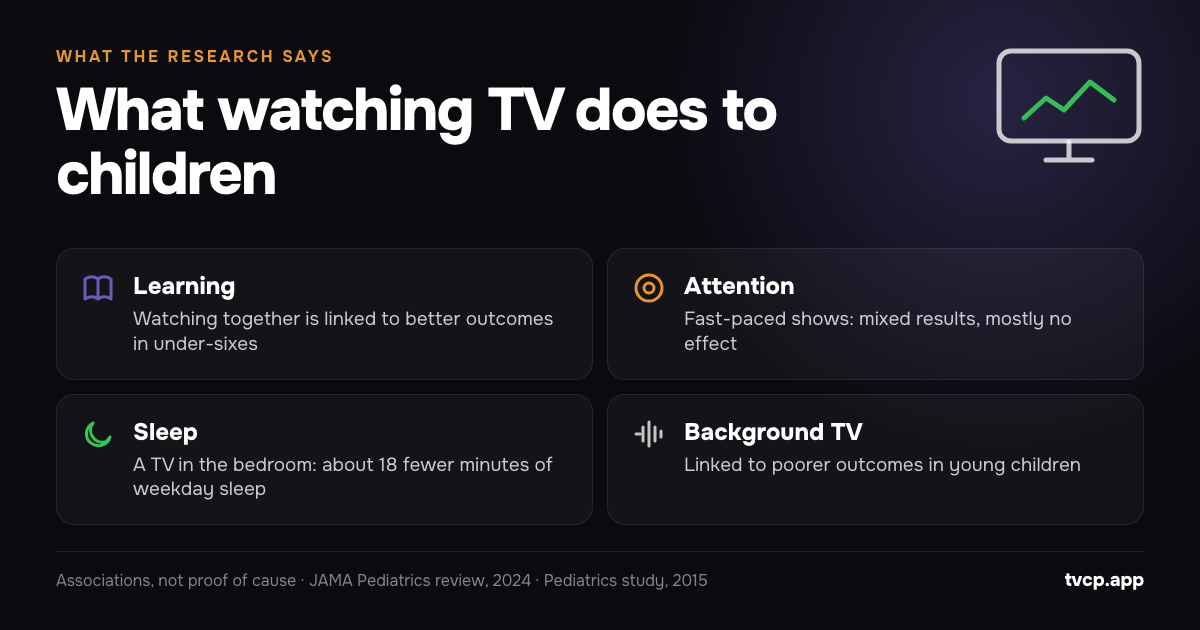
The 2024 review associated shared screen use with better cognitive outcomes in under-sixes, without establishing causation. Review of shared use.
Try making a small connection to everyday life. After a story about sharing, you could ask, “What could they have done instead?” After a programme about animals, choose a book on the same subject.
Let the conversation be brief. If your child wants to talk, listen. If they want to move on, let them. Our suggestion is to leave room for curiosity, rather than make every viewing session into schoolwork.
When choosing something educational, ask what you want from it. A counting programme, a story to enjoy together and a film for a rainy afternoon can each have a place in your plan. Give each a clear beginning and end.
Does TV affect children’s attention?
In the 2024 review, six short experiments on fast-paced content gave mixed results, and most findings showed no effect either way. Review of pacing studies.
For choosing a programme, use a practical test: can you follow the story, and does your child seem comfortable watching it? If it feels frantic, try a simpler option. You do not need to prove that a show is harmful before deciding it is a poor fit for this afternoon.
Keep any notes specific. “She asked us to stop this episode” is more useful for choosing tomorrow’s show than “cartoons are bad for her attention”.
If you are worried about persistent attention difficulties, bring the wider pattern to your child’s clinician. Include school, play, sleep and viewing in that conversation, rather than trying to identify a diagnosis from TV habits alone.
Does violent TV affect children’s behaviour?
Age-inappropriate content deserves care: the 2024 review of children under six associated it with poorer behavioural and social-emotional outcomes. That does not predict an individual child’s response to one scene. Content findings.
When previewing a programme, look beyond whether there is blood. Ask how the story treats hurting people, humiliation, intimidation and making amends. Would you be comfortable talking about what happens?
Read the content notes for a specific title, then make your own choice. If a programme is outside your child’s rating range, choose something else. If it is within range but feels wrong for your child, you can still leave it for later.
If something upsetting appears, stop and ask what your child understood. You could say, “That looked frightening. What did you think was happening?” There is no obligation to finish the episode.
Does watching TV affect children’s sleep?
TV in the bedroom and more viewing have been associated with shorter sleep, although observational research cannot establish the cause on its own. A 2015 study of 2,048 fourth- and seventh-graders found that children with a bedroom TV reported about 18 fewer minutes of weekday sleep than those without one. Pediatrics study.
That is an average difference in a study, not a forecast for your child. The study was cross-sectional and used reported sleep, so it cannot tell us what would happen if one particular family moved its TV. Study methods and results.
For a practical boundary, the AAP recommends avoiding screens in the hour before bed and keeping devices out of bedrooms. AAP’s 2026 sleep recommendations.
Start by making the last programme fit the cutoff. Choose it early enough to finish, then leave the TV off while you do the rest of the bedtime routine.
Does background TV matter if nobody is watching?
Background TV was associated with poorer cognitive outcomes in young children in the 2024 review, without proving causation. Background-TV findings.
Try switching it off when the programme ends. If you want something to listen to while preparing food, choose music and see whether you prefer that arrangement.
When reviewing the week, include the TV that was simply left on as well as programmes deliberately selected. Keep the exercise manageable: a few honest notes are enough to start a conversation at home.
What matters besides the number of hours?
What viewing crowds out matters alongside its content and duration. The AAP’s 5 Cs asks parents to consider the child, content, calm, crowding out and communication. AAP framework.
Use those questions to examine your own day. Is there still time to talk over dinner, go outside, read and get ready for bed? What would you like more room for?
For a younger child, try planning a shared book or a game before deciding when the TV goes on. For an older child, ask which activities they want to keep time for. Put those into the plan too.
This is also how we would approach cutting back: choose what you want to add to the day, then decide what viewing to shorten. You might start with the unused TV at dinner or the last episode before bed.
How can I make the TV follow a better routine?
Make one clear rule, such as a viewing window that ends before the bedtime routine.
On Android TV and Google TV with the Google Play Store, TVCP can set that schedule and let you lock the TV from your phone. Explain the stopping point before viewing starts, then use the controls to follow the plan.
For age guidance, read How Much TV Is Too Much? Screen Time by Age, 2 to 12. For the TV settings, see Screen Time Limits on Android TV & Google TV.
Related guides
See What Apps Are Used on Your Child's Android TV or Google TV
See which apps were used on your Android TV or Google TV, and for how long, from your phone. TVCP's Activity is free for every family.
How Much TV Is Too Much? Screen Time by Age, 2 to 12
What WHO, AAP and Canadian guidance say about screen time from ages 2 to 12, and how to turn that advice into a workable TV routine.
What Can My Child Watch at 4, 8 and 12?
A practical guide to choosing TV and films at 4, 8 and 12, with familiar examples, official ratings and questions to ask before pressing play.